


Having a huge presence in the ocean catamaran market, most notably with the Lagoon and Outremer ranges, VPLP Design pays considerable attention to new trends in blue-water cruising.. Customer profiles change and with them come different expectations that designers must respond to. Katia Merle, structural engineer and architecture at the firm since 2019, and Mathias Maurios, partner architect at VPLP, explain.
“Spaciousness, level sailing, course stability, comfort, shallow draught, and good average speeds: the advantages of cruising catamarans have been attracting round-the-worlders for years,” says Mathias Maurios. Which is why architects – especially those at VPLP Design, a long-time player in this market – have been paying particular attention to their design. It’s a market which has in recent years been evolving, experiencing a paradigm shift in terms of the clientele for ocean cruising catamarans.
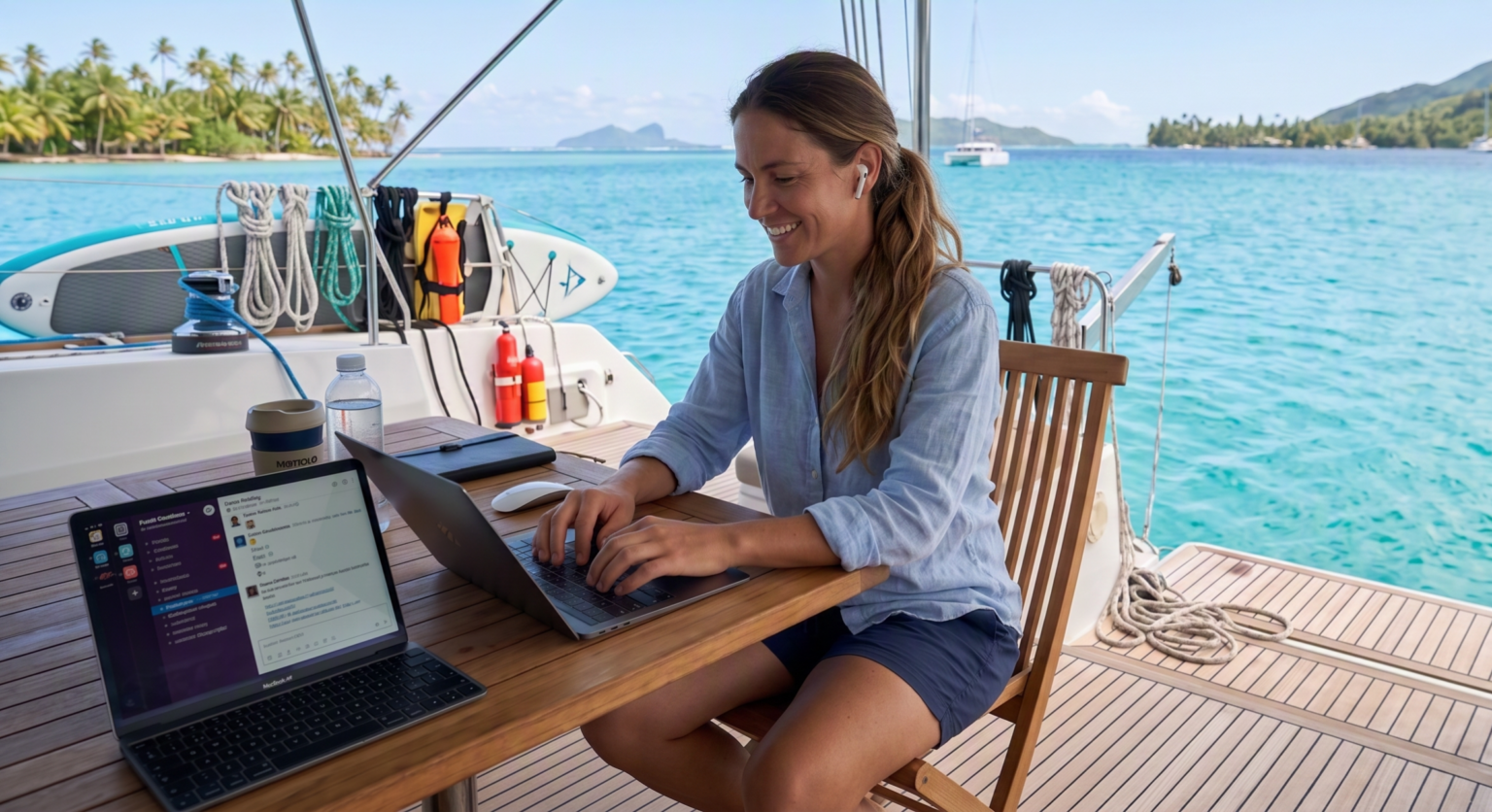
“It used to be that people waited for retirement and the sale of their house before setting out on a blue-water voyage,” adds the head of VPLP’s Cruising Division.. “They would have owned one or two boats beforehand, and increased their skills to a level of independence. There was a ‘taking the leap’ aspect to it, no going back. Today, customers are noticeably younger, less hardened sailors.. They are often people taking some time out or continuing their professional activities from aboard ship.”Il s’agit souvent de gens en activité qui s’offrent une parenthèse ou continuent de travailler depuis le bord.”
In short, “digital nomads” who leverage the ease and affordability of satellite communications to maintain contact with the shore. “This doesn’t just concern work but school too, which a mere ten years ago was a big stumbling block,” says Katia Merle. “Setting off on a sailing boat is much less of a commitment in terms of isolation than it used to be.”
Design That Adapts
In terms of architecture, these changes certainly have repercussions. “In the specifications for the builders, sea-keeping qualities, self-sufficiency, ease of use and comfort are the watchwords,” says Mathias Maurios. And how does that translate in practical terms to catamaran architecture? “Energy constraints are taken into account at the concept stage with, notably, the integration of solar panels and by multiplying energy sources,” says the architect. “Spaces in the stern can stow more gear and larger motorized tenders.”
And Mathias Maurios adds: “Rigs are also simpler to use,with square-head mainsails that are higher although smaller compared to reaching sails. Winches are lower so you don’t have to be as tall to turn the handle, and air-conditioning is being installed which only fifteen years ago was something found only on luxury yachts. And on the accommodations side, an owner’s version exists with a cabin that can be turned into an office or a studio.”ne cabine transformable en bureau ou en atelier.”
With a boat no longer being an end in itself but a means to an end, the focus is also on the interface between the internal accommodations and the external deck areas. In other words, living on a single level. “The ‘I cook below, you sail the boat above’ scenario is over!” says Katia Merle.. “The new customer profiles are less accepting of discomfort. Once upon a time, making do was a feature of long-haul sailing but people today don’t want the hassle. ..les gens veulent se faire plaisir. Loading capacities have increased considerably. Cats have become platforms for exploring and families are taking more toys with them to enjoy the thrills of board sports at moorings.”
“We sense a need for authenticity, for taking a break, and for an exceptional experience,” says Mathias Maurios. “People who set off for three years take the Panama Canal and do a complete circumnavigation. Even via the trade winds it requires long passages and stopovers in places unknown to global tourism.” An adventure that even today requires a high level of self-sufficiency, as much in the management of resources as in the capacity to sail and maintain the boat in demanding conditions.
For a growing section of the sailing public, simplicity and sobriety remain essential components, ensuring peace of mind and a sense of freedom, and take precedence over the temptation to recreate all the creature comforts found ashore. In today’s increasingly competitive sector, builders can also stand out from the crowd by marketing a light sailing boat offering superfluous sea-keeping qualities and energy self-sufficiency when living aboard – a combination that opens the door to adventure. The new profiles of today’s round-the-worlders don’t hesitate to receive support in areas as diverse as engine maintenance, medicine, electricity and safety. Attentive to these new requirements, boatbuilders are offering more and more training courses, services, and even flotilla sailing so you can discover the world without the worry.


